
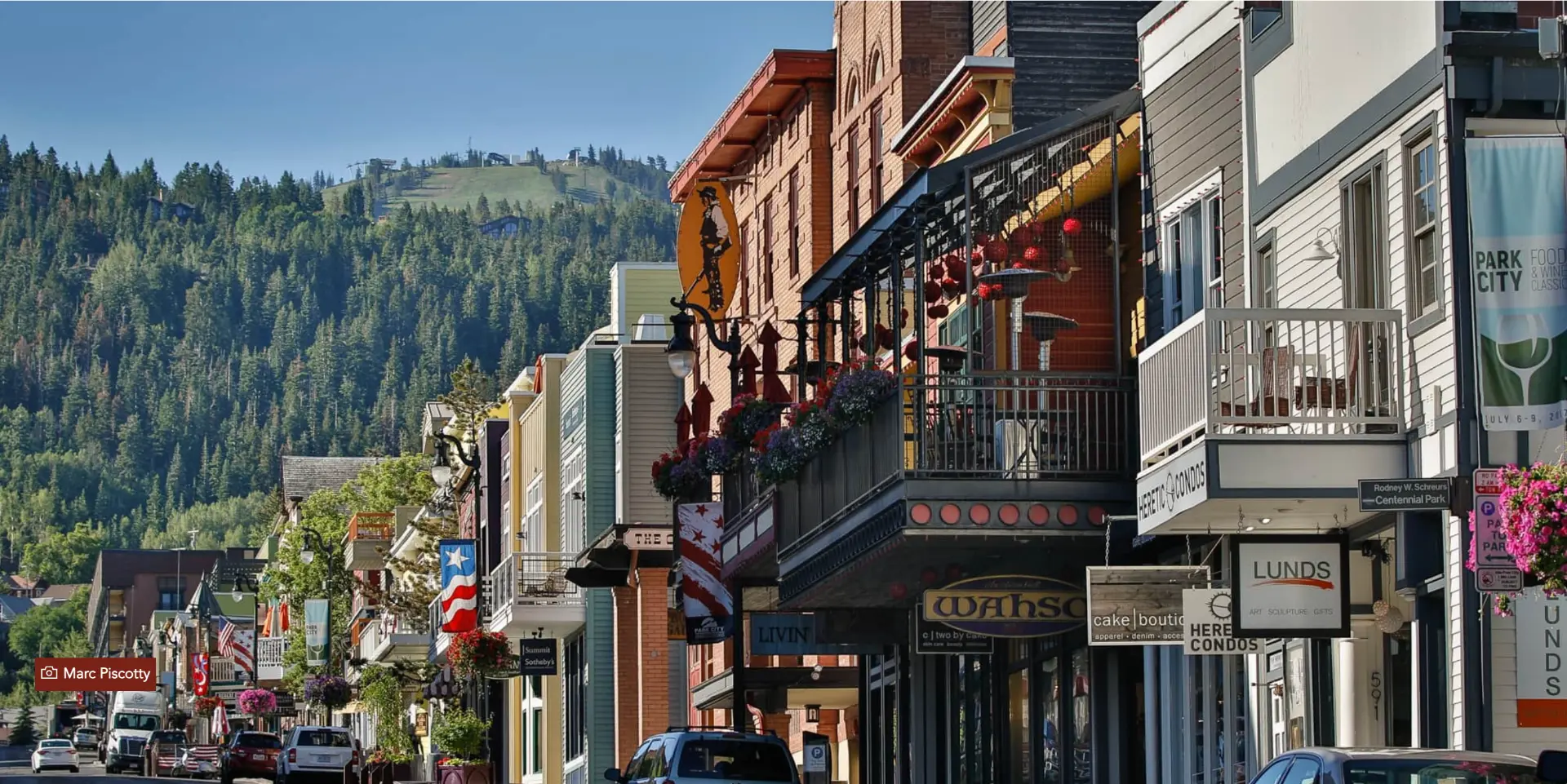
What it feels like to live in Park City
Park City is a true mountain town that happens to sit 35 minutes from an international airport — the combination that drives most of its demand.
Old Town climbs the hillside above historic Main Street in a dense grid of restored miner's cabins and modern infill, all within walking distance of restaurants, galleries, and the town lift.
Deer Valley and Park City Mountain bracket the town with ski-in/ski-out inventory, while Prospector, Thaynes Canyon, and Park Meadows serve the year-round local population.
The Snyderville Basin — Kimball Junction, Silver Springs, Jeremy Ranch, and Pinebrook — offers the practical version of Park City living at a lower entry point with a short drive to the lifts.
Food & Beverage Scene
Main Street holds one of the densest concentrations of high-end restaurants in the Mountain West, with a serious apres and cocktail scene.
Kimball Junction covers everyday dining, groceries, and casual options for full-time residents.
Sundance in January reshapes the entire town's dining and traffic patterns for roughly ten days each year.
Schools & Education
Park City School District is small, well-funded, and consistently rated among the top districts in Utah.
Park City High has strong academics alongside nationally competitive ski and outdoor programs.
Private and independent school options serve part of the second-home and international community.
Park City Housing Market
This is a resort market and behaves like one: pricing is driven by ski access, view corridors, and rental potential rather than commute time.
Ski-in/ski-out condominiums and Deer Valley product carry the highest premium; Snyderville Basin single-family homes are the entry point for full-time residents.
Nightly rental zoning varies significantly by neighborhood and HOA — that detail alone can swing a property's value substantially.
Pros & Cons
- Two world-class resorts plus year-round trail access
- 35 minutes to Salt Lake International Airport
- Exceptional restaurant density for a town this size
- Top-rated small school district
- By far the highest price point covered in these guides
- Canyon traffic on powder days and during Sundance
- Nightly rental rules vary by zone and HOA — due diligence is essential
Frequently Asked Questions
Can you live in Park City full time and commute to Salt Lake?
Many people do. It is roughly 40 minutes to downtown Salt Lake and 35 to the airport via I-80, though winter storms can extend that significantly.
What is the difference between Old Town, Deer Valley, and the Snyderville Basin?
Old Town is the historic walkable core above Main Street, Deer Valley is upscale resort and ski-in/ski-out inventory, and the Snyderville Basin — Kimball Junction, Pinebrook, Jeremy Ranch, Silver Springs — is where most full-time residents live at a lower price point.
Can I rent my Park City property nightly?
It depends entirely on the zoning and the HOA. Some neighborhoods allow nightly rental, others restrict to 30 days or longer. Confirm this before writing an offer — it materially affects value.
Is Park City worth it compared to buying in the Salt Lake Valley?
If ski access and mountain-town lifestyle are the priority, yes. If value per square foot and commute are the priority, the valley delivers far more house for the money.
Want a deeper breakdown of Park City real estate or unlisted properties? Connect with Alex Huber.
I'll send current Park City comps, off-market opportunities, and a straight answer on what your timeline realistically buys.